
In the fourth and final instalment of the Ka huri te kei o te waka: Māori Agribusinesses Navigating Land Use and Enterprise Transition series, we look at Te Pū Oranga Whenua, a wāhine-led collective shortening supply chains to put nutritious, affordable kai on whānau kitchen tables. Te Pū Oranga Whenua is one of four Māori agribusinesses partnering with the Bioeconomy Science Institute Maiangi Taiao through its Land use transitions to enhance Māori communities programme, alongside Kānuka Charitable Trust, Mānuka Performance and Te Kautuku Trust.
Local level solutions
In recent years, cyclone and flood affected rural Māori communities have experienced the fragility of food systems firsthand, as damaged roads and bridges have cut off access to supermarkets and disrupted the delivery of essential kai. But for many whānau, natural disasters are only part of a wider story. Rising living costs and limited access to affordable, healthy food are also driving ongoing food insecurity.
Māori community leaders in highly productive agricultural regions have questioned why local whānau struggle to access kai when so much is produced on their own whenua for national and international supply chains. Among those bringing attention to this issue are the members of Te Pū Oranga Whenua, who are working to shorten the distance between the whenua and the whānau kitchen table.
Te Pū Oranga Whenua is a wāhine-led, inter-regional collective of Māori agribusinesses formed in 2021 through a shared commitment to kai sovereignty and community wellbeing. Its members are focused on reimagining how land utilisation and the agricultural industry can better support the environment, local food production and employment. Through their partnership with the Bioeconomy Science Institute Maiangi Land Use Transition programme, Te Pū Oranga Whenua are advancing their research into local-level solutions that build community resilience and reduce dependence on industrial food systems.
Accessing support and expertise
Bonny Hatami (Ngāti Pāhauwera, Clan McLean, Rakaipaaka, Ngāi Tūhoe), Lisa Warbrick (Te Āti Haunui-a-Pāpārangi, Ngāti Maru, Ngāti Awa, Ngāti Rangitihi), and Tracey Bayliss (Tangata Tiriti) represent Te Pū Oranga Whenua on the Land Use Transition programme. The kaupapa Māori programme recognises that there is no single pathway for change and that Māori agribusinesses are navigating different transition journeys.
Te Pū Oranga Whenua is part of the Shortened Supply Chain Transition workstream, which supports Māori agribusinesses moving away from large-scale, export-oriented supply chains toward kai sovereignty: putting kai back in the hands of whānau and hapū. Through the programme, Te Pū Oranga Whenua has accessed the support of Kairangahau Māori and the expertise of scientists and researchers to help continue their research to support the further development of two key projects: a mobile abattoir model and research supporting small-scale whenua Māori and kai systems.
Addressing a real sector need
Lisa says the idea for TākiToa, a turnkey mobile abattoir model for Māori communities, emerged four years ago from a simple question posed to her and Tracey by the CEO of Ngāti Pāhauwera Development Trust: “How can we get our beef from the farm to our whānau?” Since then, the two women have been developing a solution that they say also addresses a real sector need. Small-scale farmers often struggle to access processing facilities, and when they do, much of the value is lost through long and costly supply chains.
The Bioeconomy Science Institute Maiangi Taiao Land use transitions to enhance Māori communities programme has helped Lisa and Tracey better understand and articulate the model. “They didn’t fund the hardware or pay our skilled people; that was our own investment,” she says. “What they brought was the research capability to help us define our story and understand the technical dimensions, including short supply chains, data integration in a mobile system, meat quality, and health and safety. That was invaluable.”
“We also used the programme to explore nose-to-tail utilisation, minimising waste and making organ meat relevant again because of its nutritional value. We're investigating other markets too, like the Halal market for our Muslim and Indian communities.”
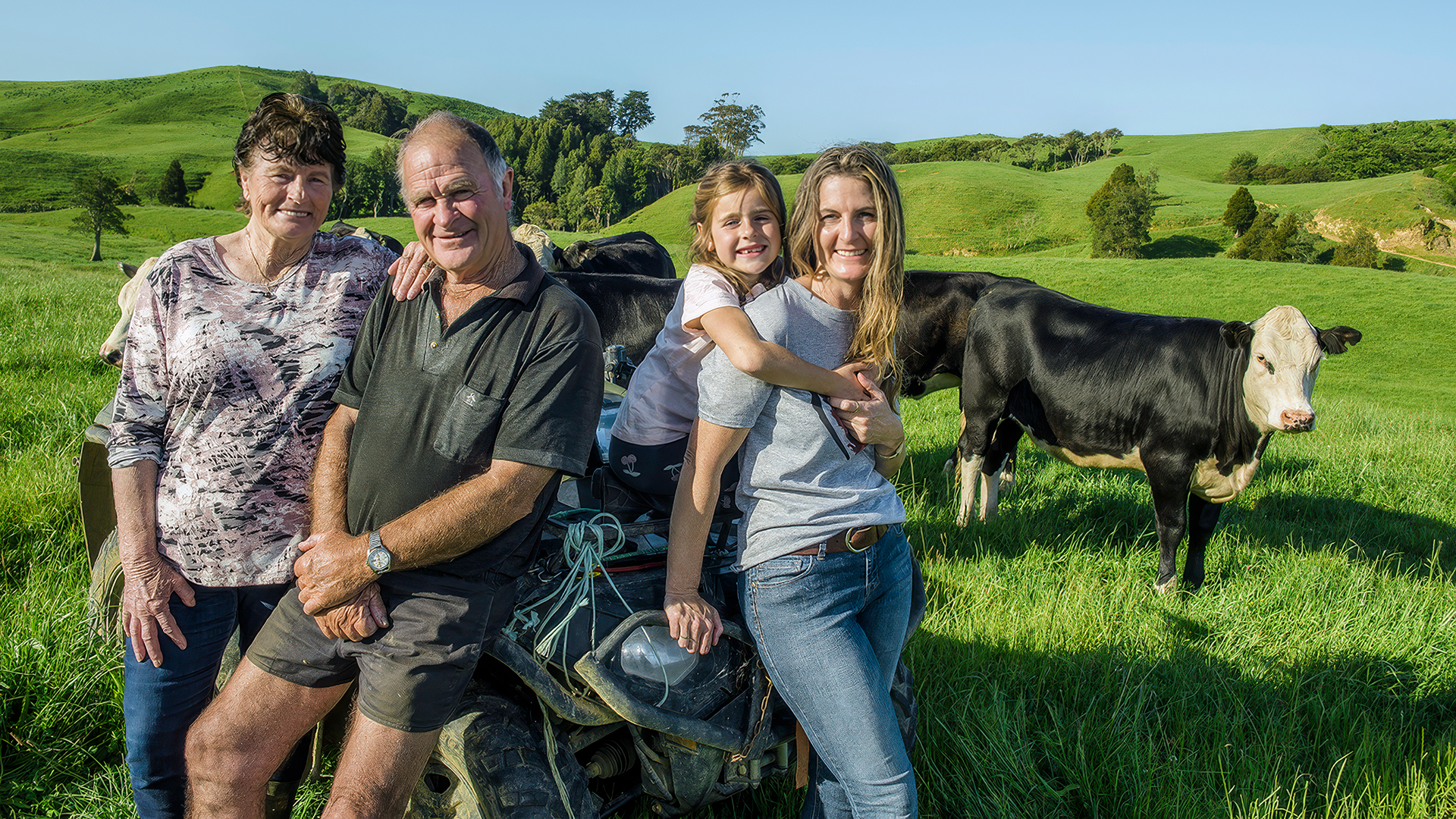
Brookdell Farm, owned by Cliff and Maureen Bayliss in Te Uku, Whaingaroa, provided operational support for phase one of the TakiToa mobile abattoir. Tracey, a director of TakiToa (and TPOW), is also a member of the Bayliss whānau, who also run Grandad’s Beef from Brookdell Farm. (Left to right): Maureen, Cliff, Brooklyn and Tracey Bayliss.
Kai plays a central role
Bonny’s research under the Bioeconomy Science Institute Maiangi Taiao Land use transitions to enhance Māori communities programme has focused on small Māori land blocks and kai systems in the Ngāti Pāhauwera rohe. “We’ve got a lot of historical evidence and previous research to draw on,” she says, “and kai has always been central to that story.”
Through the research, Bonny has identified a wide range of capabilities and constraints across small land blocks. “We found a real spectrum,” she says. “Some small landowners can’t do much on their whenua because they don’t have access to resources. Others in the middle would like to work cooperatively, but aren’t sure how. Then there are larger entities who have worked hard to establish themselves and are now looking at how they can support smaller blocks.”
She says the key question is what is missing in current kai systems, and how whānau can be better supported to transition. “A shortened supply chain is something we saw could significantly benefit communities at all levels, supporting access to healthy kai, lowering costs, and keeping things closer to home.”
Be prepared to pivot
Senior Scientist Vicki Burggraaf and Senior Statistician Esther Meenken, from the Bioeconomy Science Institute, have been supporting Te Pū Oranga Whenua with its research activities. For Vicki, this has included conducting interviews for Ngāti Pāhauwera whānau case studies, while Esther has been working closely with Lisa to co-lead the Māori Data Governance workstream that will benefit both the programme and the organisation more broadly.
Vicki says one of the key learnings that came through from interviewing whānau was the importance of adaptability when making a transition. “They talked about being prepared to pivot and if something doesn’t work, it’s about understanding why and whether it can be fixed, rather than giving up or changing direction too quickly.”
A key lesson Esther has drawn from her Māori data governance mahi is that how the data is being governed is just as important as what data is collected. She also says reciprocity sits at the heart of good engagement, not just in how knowledge is shared, but in how projects are resourced. “When Crown institutes are working with Māori, mana is a must.”
Bonny and Lisa say Te Pū Oranga Whenua has a range of insights and learnings they are keen to share with other Māori landowners considering transition pathways. Bonny says whānau do not need to navigate the journey by themselves. “You don’t have to start with a Google search or do things the hard way,” she says. “Send us a message or reach out if you would like to have a kōrero.”
She says the collective is also building resources to support whānau, including a podcast series, Te Karanga o te Whenua – The Call of the Land, developed with the Bioeconomy Science Institute Maiangi Taiao. “Our hope is that these stories will resonate with and inspire whānau who are just beginning their own journey.”
Lisa encourages Māori landowners and agribusinesses to engage with the Bioeconomy Science Institute Maiangi Taiao. She says there is strength in bringing together mātauranga Māori and Western science, enabling shared learning and new opportunities for whānau-led innovation. “Some of my whānau in Whanganui had never worked with Western science until three years ago. Now they have multiple research projects with science. It’s provided resourcing and ‘aha’ moments that can be leveraged from.”
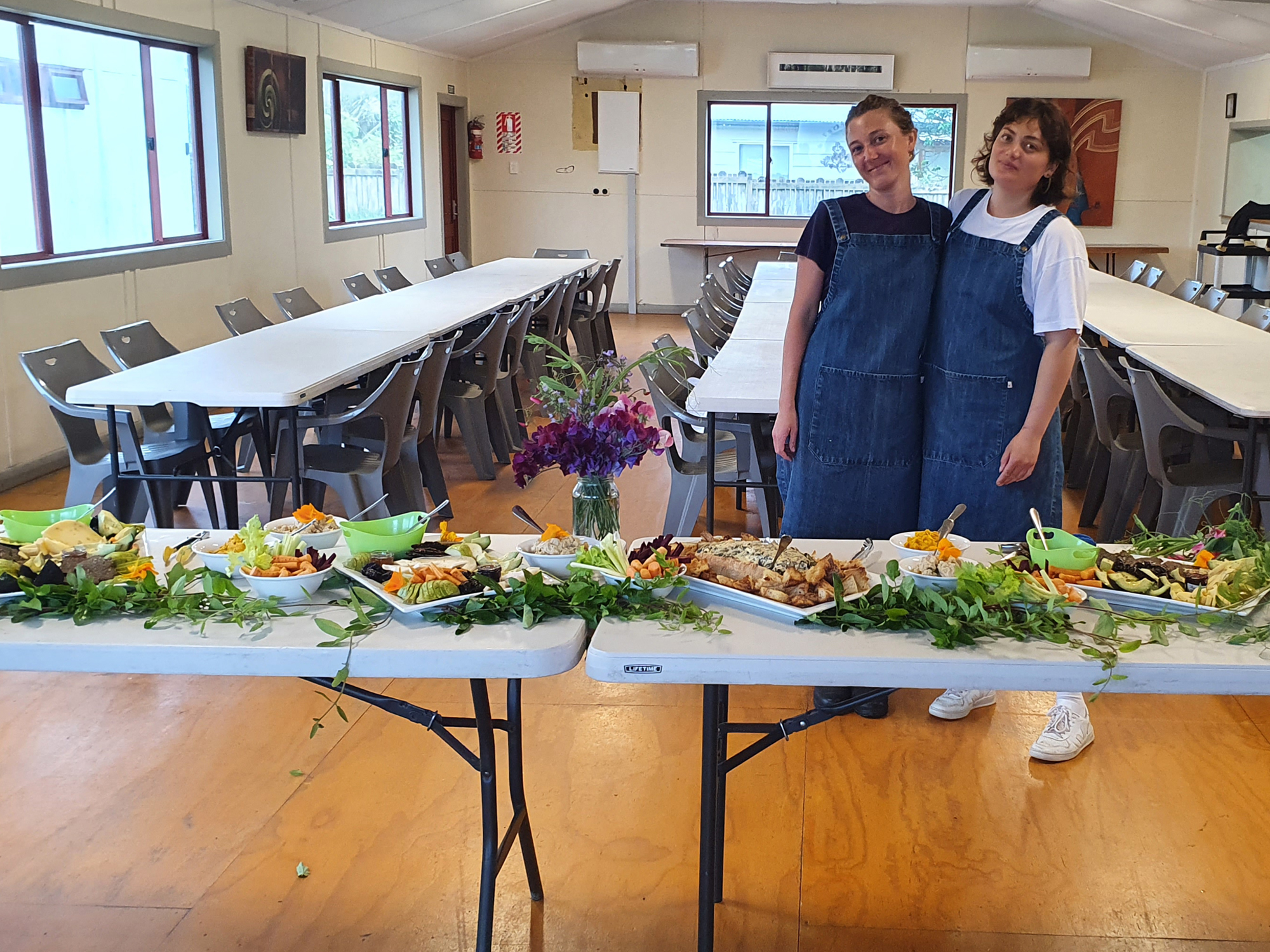
Healthy kai at Poihakena Marae
Find out more
Te Pū Oranga Whenua welcome enquiries from Māori landowners and Māori agribusinesses considering transition.
orangawhenua.nz.