
Thursday, 19 November 2026
A three-year pilot will test at pre-commercial scale whether insect bioconversion (IB) can work alongside anaerobic digestion (AD) to turn Marlborough’s organic waste into valuable products, including protein for animal feed and nutrient-rich soil amendment.
The $2.6 million pilot, led by Marlborough Research Centre (MRC), with guidance from the Bioeconomy Science Institute Maiangi Taiao (BSI), is supported by $1.42 million from the Waste Minimisation Fund (WMF), subject to meeting agreed milestones and stage-gate requirements.
“This multi-year research programme has the potential to deliver practical benefits for Marlborough and the wider region. We’re pleased to have secured central government support through the Waste Minimisation Fund for the Insect Bioconversion / Anaerobic Digestion Pilot,” says John Patterson, Chief Executive, Marlborough Research Centre.
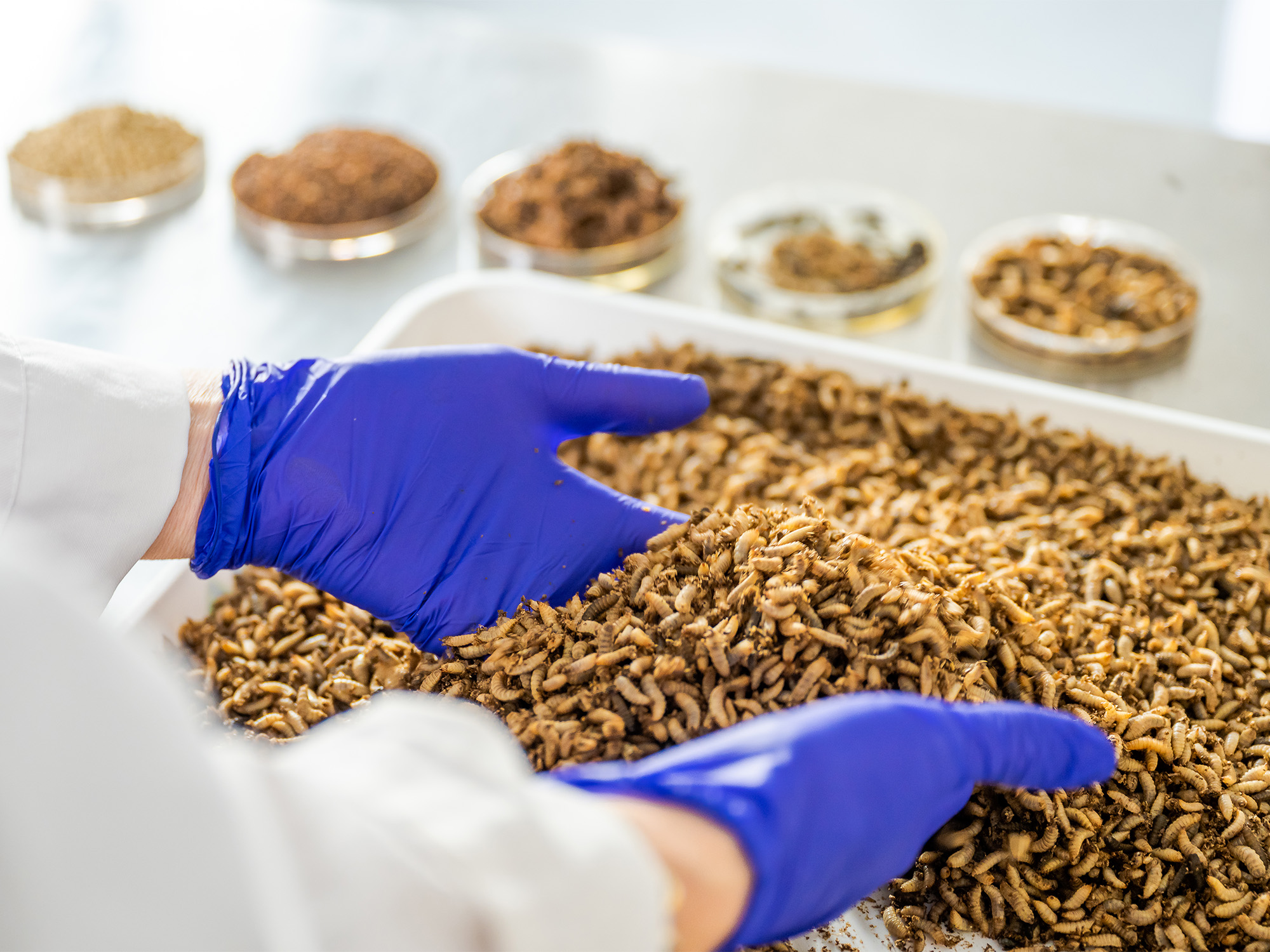
Black soldier fly larvae
The pilot focuses on developing IB alongside a proven organic waste processing technology (AD) in order to improve overall waste processing economics and minimise the infrastructure investment requirement for a full-scale commercial processing facility. The project brings together MRC, BSI, Marlborough District Council, Ecogas and Kōrure to develop a regional business case for making better use of Marlborough's organic waste.
In the project, Ecogas and MDC will work together to generate a precise profile of the region’s organic waste and trial collection strategies to enable diversion from landfill. Ecogas is also keen to understand the potential benefits of integrating IB with AD. A key output for the pilot is the development of a business case and a commercialisation pathway for a co-located AD / IB facility in the Marlborough region.
Kōrure is a NZ natural health and pet supplement company with experience in extraction and manufacturing and will join the pilot as the IB operator. Dry Food NZ will provide drying and milling capabilities. Numerous commercial stakeholders are involved in the project to help develop and evaluate products made from the insect larvae and their by-product, frass, a mixture of insect excreta, exoskeletons and some unconsumed feed.
“Insect bioconversion has the potential to shape New Zealand’s circular economy. As the pilot’s insect bioconversion operator, Kōrure is focused on developing a real-world solution for Marlborough with the potential to expand across New Zealand,” says Ron Park, CEO of Kōrure.
An estimated 25,000 tonnes of organic waste goes to landfill in Marlborough each year, adding to disposal and emissions costs for the community. Organic by-products from the primary sector add to this, and together they represent a large, underutilised resource for the region. Marlborough District Council will also trial a small kerbside collection of food and green waste throughout the project.
“This pilot aligns with the Council’s new direction for waste management, making it both timely and exciting. By transforming waste streams into valuable resources, the project will deliver environmental and economic benefits for our district, reduce waste sent to landfill, and help lower greenhouse gas emissions,” says Mark Lucas, Solid Waste Manager, Marlborough District Council.
The pilot will harness the remarkable bioconversion efficiency of black soldier fly to convert organic material into protein-rich larvae and nutrient-rich frass. The larvae will be assessed as a potential source of protein for pet, poultry and aquaculture feed, while frass will be evaluated as a nitrogen-rich soil amendment. The pilot builds on five years of work by BSI and MRC, including the MRC commissioned and AGMARDT co-funded Top of the South Organic Waste Mapping Study and research trials showing that side streams from winegrowing and aquaculture can be used to formulate a high-quality insect diet.
“Insects are one of the most efficient converters of low-quality organic molecules into high-quality protein on the planet. Thanks to its remarkable primary sector footprint, Marlborough is uniquely positioned to harness that efficiency to develop profitable circular solutions for processing organic side streams,” says Abby Albright, Horticulture Sector Business Manager at the Bioeconomy Science Institute.
Combining AD and IB would enable shared receiving and sorting facilities, avoid duplicating waste transport and make use of waste heat. The pilot will determine if co-location improves bottom line commercial performance of each operation. It will also produce a business case and implementation plan for a future commercial-scale facility able to process up to 50,000 tonnes of organic waste a year.
This is a community initiative being administered and coordinated by MRC. It is hoped that in addition to filling critical knowledge gaps, the pilot will facilitate broader community and stakeholder engagement to address how the region can pull together to make the best possible use of its unavoidable
organic waste streams.
Media contact
If you’re a journalist interested in this news, please contact a member of the communications team:
Greg Ford, Principal Communications Advisor
Email: greg.ford@agresearch.co.nz
Mobile: +64 (0)21 832 351
Justine McLeary, Senior Communications Advisor
Email: justine.mcleary@scionresearch.com
Mobile: +64 (0)27 241 5649
Maja Burry, Senior Communications Advisor
Email: maja.burry@plantandfood.co.nz
Mobile: +64 (0)27 437 5408