
Thursday, 15 October 2026
Janet reconstructs past ecosystems from fossil evidence including pollen, charcoal, seeds, bones, preserved dung, and ancient DNA.
She used radiocarbon dating of seeds gnawed by kiore (Pacific rats) to establish that the rats were introduced to Aotearoa New Zealand around 1280 by the first Māori settlers. Later, she also updated the timings of human arrival across East Polynesia.
Her research spans ecological histories and lost plant-animal interactions, including revealing how early fires cleared vast areas of lowland forest within decades, what moa once ate, and lost animal-plant interactions (such as pollination of the threatened Te pua o te rēinga, the parasitic wood rose, by kākāpō).
Janet’s research also revealed the devastating impact, and subsequent recovery from, the last Taupō eruption and cyclonic storms on lowland forests of the eastern North Island. These baseline studies help us to understand how long it takes for forests to recover from contemporary disturbance.
Her insights from the past offer Māori entities, conservationists, and land managers new evidence to inform restoration of whole landscapes and individual species.
Janet says the most exciting thing about being a palaeoecologist is not knowing what you're going to discover from collected samples.
These samples may come from the bottom of lakes, bogs, or caves. They may contain ancient bones, seeds, charcoal, and preserved dung, called coprolites. Analysing these can reveal a lot, Janet says.
“Coprolites contain a fascinating bundle of information, they are like a black box for an animal that lived in the past – telling us what they ate, what seeds they dispersed, what plants they were pollinating, their health, all from droppings deposited way back in the past. It’s phenomenal, like a piece of history just lurking in the ground.”
And the secrets they contain are often surprising, such as ancient kākāpō droppings that were found to contain pollen from New Zealand’s only indigenous fully-parasitic flowering plant Te pua o te Rēinga – the New Zealand Wood Rose (Dactylanthus taylorii).
“Such high levels of pollen could only have meant that the bird was either eating the flowers or drinking nectar from the huge nectaries that this plant has. This is exciting, because up until then, this plant was thought to only be pollinated by the threatened pekapeka-tou-poto, or short-tailed bat. Now we think nectar-drinking birds could have also played that role.”
This information gives hope to sanctuary managers that nectar-drinking birds, such as tīeke, or saddlebacks, could also pollinate the plant where the two species co-exist, and allow it to reproduce.
“That's a pretty exciting finding and it makes you feel like you're doing something really useful helping to protect taonga species.”
Janet is fascinated by past plant–animal interactions and what they can tell us about current ecological issues.
“Understanding the diets of extinct moa informs the debate about herbivory in natural ecosystems today,” she says.
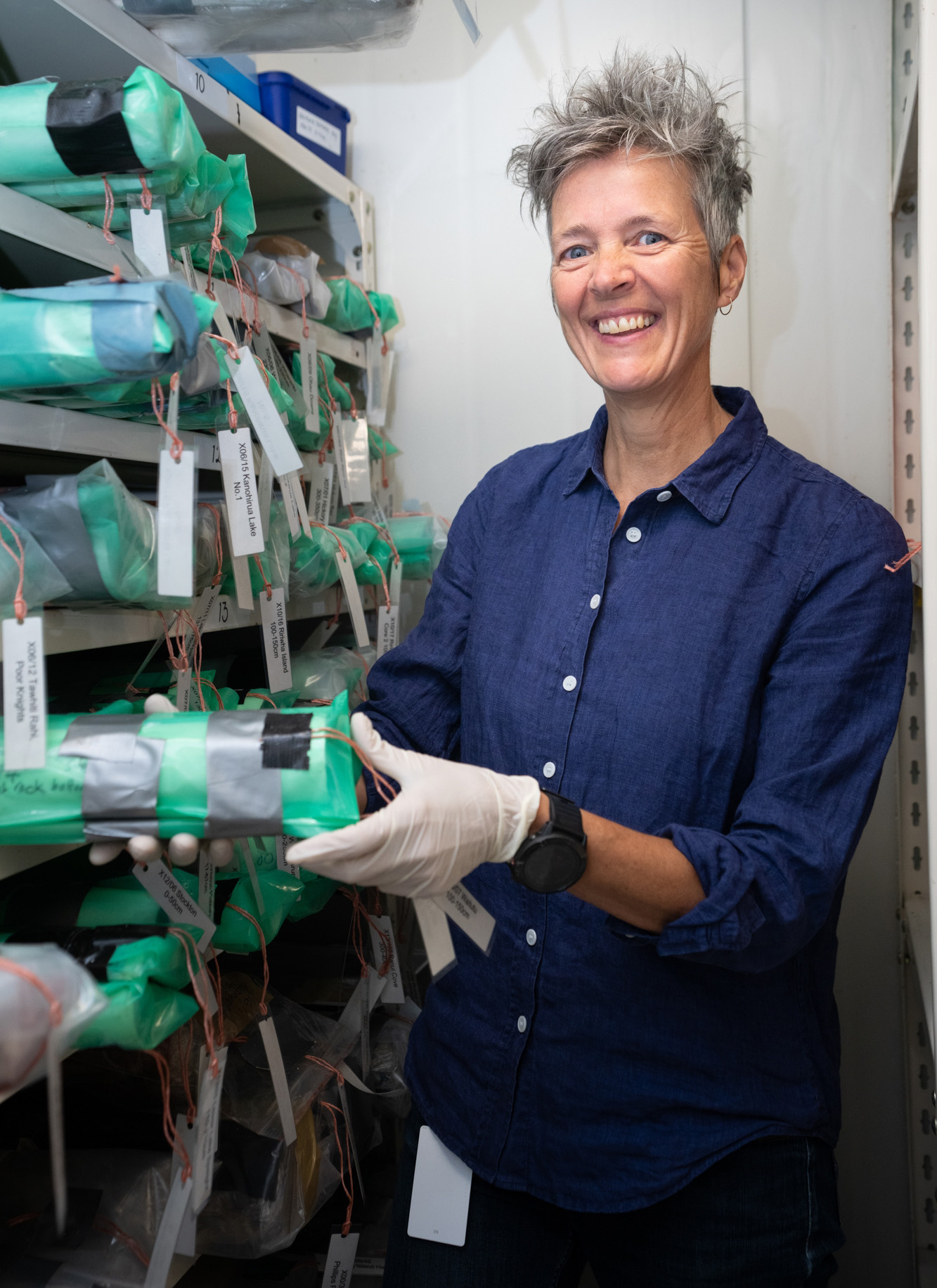
Janet Wilmshurst in the Long Term Ecology Laboratory
The pivotal moment of Janet’s career was finding seeds that had clearly been gnawed on by kiore - the introduced Pacific rat.
"I remember finding these seeds on the surface of a swamp that had been drained and thinking, ‘oh my goodness, nothing else can leave bite marks like that on a seed. We could radiocarbon date these seeds across the country and find the oldest rat-gnawed seed and be able to tell exactly when kiore, the Pacific rat, were introduced to New Zealand by Māori'.”
Their research found the earliest date was around 1280, much later than previously thought.
“It’s amazing to make these findings that overturn ecological paradigms and contribute to debates about the timing of faunal introductions and extinctions.”
Janet also studies how vegetation has changed over time and has shown how palaeoecology can challenge our assumptions about current ecosystems. One striking example is some offshore islands in Northland, now mostly covered in pōhutukawa. Pollen, charcoal and ancient plant DNA revealed the island once supported a much more diverse forest with “conifers and palms and a rich angiosperm understorey” before it was cleared by fire, and has since been recovering.
Knowledge about past ecosystems is hugely useful to those seeking to restore landscapes. She feels privileged working with mana whenua and sharing what she’s uncovered about the prehistory of different environments across the motu.
Currently, Janet is seeking to make a national database of pollen records more accessible to mana whenua and restorationists.
“These records describe the plant communities existing just before human arrival where they no longer exist. It would be great to make this information available to those who are keen to restore the right species in the right place, to ensure resilient ecosystems into the future - whether that is for forest restoration or carbon farming with native species.”
Janet says she feels humbled and honoured to join the long list of past recipients of the Hutton Medal.
“I feel particularly proud to stand alongside the three other women who have received this medal since 1911: Lucy Moore (1965), Elizabeth Edgar (2000), and Wendy Nelson (2016).
“I hope my winning the Hutton Medal will raise public awareness about the value of being able to look back at our past ecosystems and to see how this can help us better understand and protect our remaining unique biodiversity which we have a responsibility to protect from further loss and degradation.
“I would like to acknowledge all my collaborators, including research colleagues and iwi and hapū research partners, for their shared interest and desire to expand our knowledge of, and connection to, New Zealand’s past ecosystems.
“I also owe much of my success to the Royal Society of New Zealand’s Marsden Fund, as I was incredibly fortunate throughout my career to have benefitted from this brilliant investigator-led, blue skies research fund. Their grants allowed me to pursue some of the most scientifically interesting and rewarding projects of my career.”
This article was originally prepared by the Royal Society Te Apārangi.
Media contact
If you’re a journalist interested in this news, please contact a member of the communications team:
Greg Ford, Principal Communications Advisor
Email: greg.ford@agresearch.co.nz
Mobile: +64 (0)21 832 351
Justine McLeary, Senior Communications Advisor
Email: justine.mcleary@scionresearch.com
Mobile: +64 (0)27 241 5649
Maja Burry, Senior Communications Advisor
Email: maja.burry@plantandfood.co.nz
Mobile: +64 (0)27 437 5408