
Wednesday, 22 July 2026
The Bioeconomy Science Institute Maiangi Taiao, in partnership with the Cawthron Institute and Helogen Corporation, is exploring how bacterial nanocellulose (BNC) forms in microgravity. BNC is a high-value biomaterial with exceptional strength, flexibility, purity and biocompatibility – qualities that make it highly sought after across medical, industrial, and aerospace sectors.
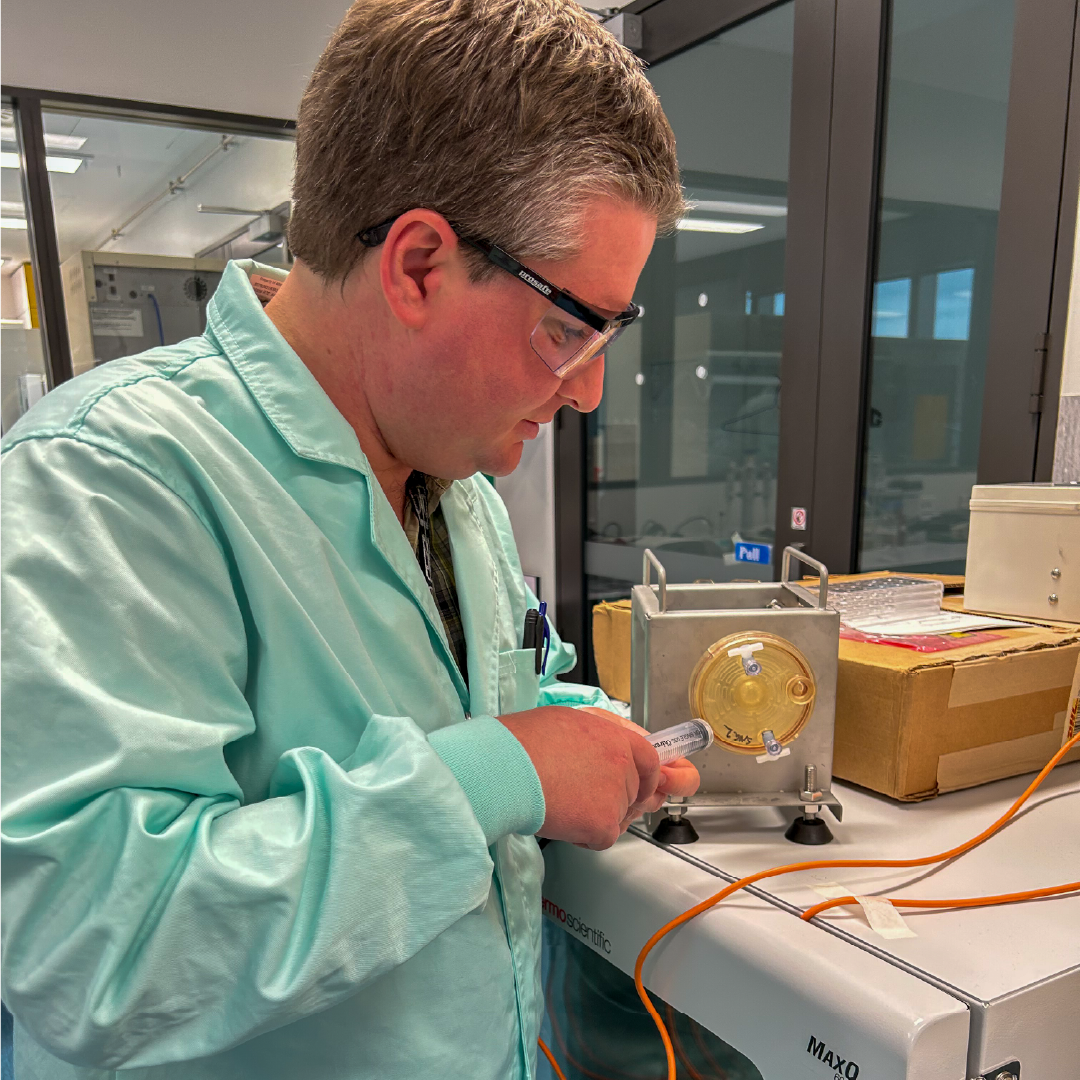
Dr David Hooks taking a sample from the simulator
In the world-first experiment, researchers will test if BNC can be produced using a co-culture of bacteria and microalgae, powered by sunlight rather than traditional sugar-fed fermentation. Because microalgae generate the nutrients needed for BNC formation using only light and carbon dioxide, the process offers a more sustainable way to create versatile biomaterials in resource-limited environments such as space.
Bioeconomy Science Institute senior scientist Dr David Hooks, who is leading the two-year research project, says ground-based testing recently got underway following the development of two low-gravity simulators.
“After months of constructing and configuring the systems, it's exciting to have ground-based testing underway. It brings us a step closer to launch and puts this project firmly on the countdown to space,” says Dr Hooks.
The simulators, formally known as HARV (High Aspect Ratio Vessel) bioreactors, are a rotating-wall vessel that mimic microgravity by keeping the contents in a continuous state of gentle free-fall.
“They’re only small – about the size of a kitchen appliance – and rotate a bit like a front load washing machine,” says Dr Hooks.
“That constant, gentle rotation keeps the growing cells, which are self-contained in a petri-type dish, suspended as if it were in orbit.”
Dr Hooks says producing BNC in low-gravity conditions may reveal new possibilities for manufacturing next-generation materials that are difficult, or even impossible, to produce under normal gravity.
“Microgravity may enhance BNC’s properties even further, enabling ultra‑lightweight composites, biomedical implants, and advanced filtration materials. These innovations could benefit industries ranging from health and biotechnology to aerospace, automotive, and marine.
“Understanding how BNC grows in microgravity could also help shape future off-planet manufacturing – a field that’s becoming critical for long-duration space missions and sustainable space habitation.”
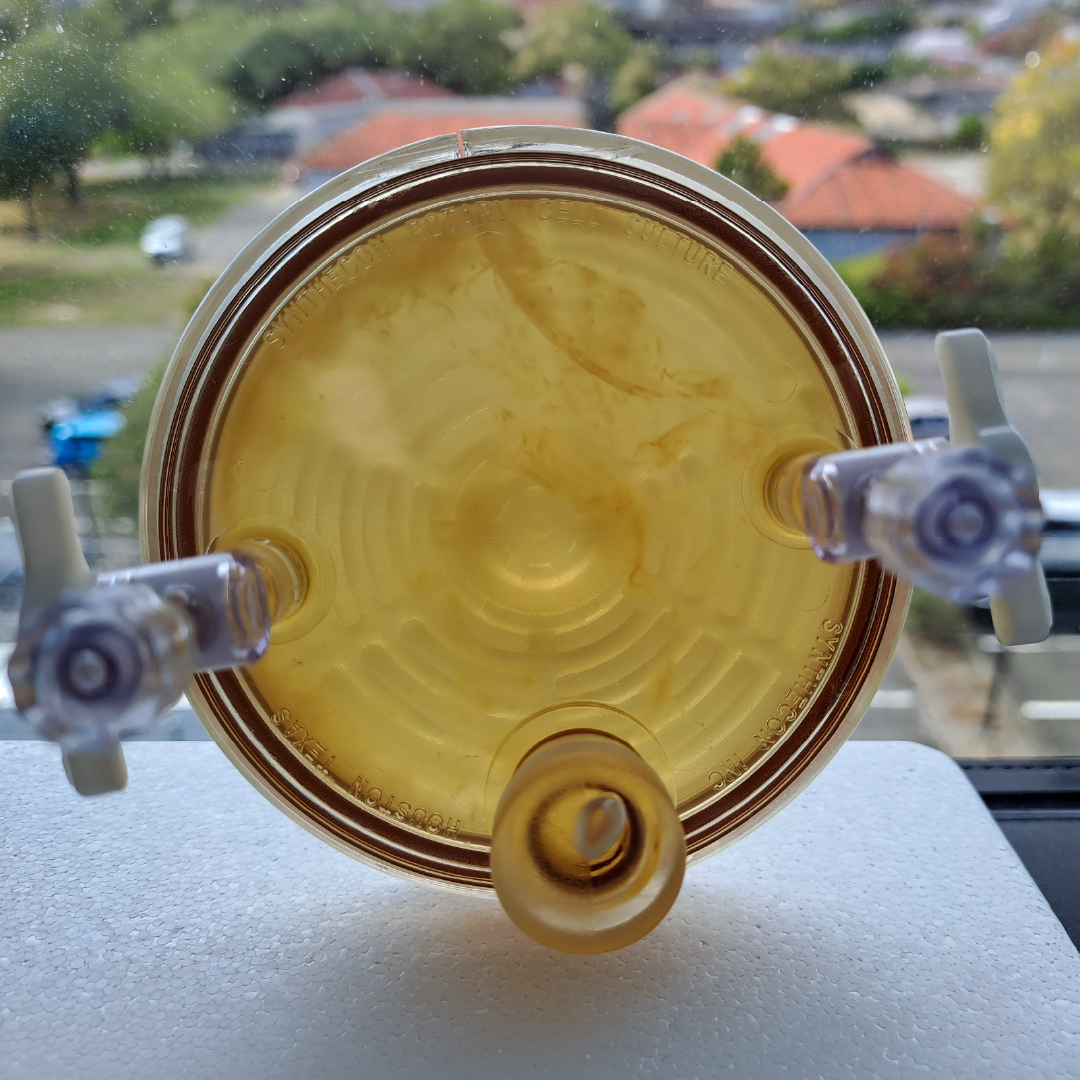
Close up showing the formation of a BNC pellicle
Cawthron Institute algae and bioactives scientist Dr Cora Hertzer says microalgae are remarkably diverse and highly adaptable.
“Exploring their symbiotic relationships with bacteria offers deep insight into the fundamental principles that shape biological cooperation. The team is excited to push this research further, especially to uncover how microalgae and BNC-producing bacteria can form cooperative partnerships in space."
Helogen chief executive Shishir Bankapur says the project brings together exactly the expertise needed to push biomanufacturing in orbit forward.
"By combining the Bioeconomy Science Institute's research leadership, Cawthron's expertise in algae, and Helogen's work at the intersection of biology and space, we're building new approaches to producing high-value materials in microgravity. This is exactly what Helogen is about – using the unique conditions of space to unlock breakthroughs that have profound impact here on Earth.”
With the simulators operational, Dr Hooks says the team will now move on to developing specialised sensing technology to monitor BNC formation, along with a miniature laboratory designed to operate autonomously in space.
The mini-lab is expected to launch in late 2027. This will be the first time a symbiotic microbial co-culture is used to produce BNC in microgravity.
“This mission will provide invaluable insights into how BNC produced in low gravity is different to that produced on Earth. It’s a mission that’s truly out of this world,” says Dr Hooks.
The $1 million project is funded by the Ministry of Business, Innovation and Employment (MBIE) Smart Ideas Endeavour Fund.
Media contact:
Caroline King – Senior Communications Advisor
Bioeconomy Science Institute
+64 (021) 913 328
Media contact
If you’re a journalist interested in this news, please contact a member of the communications team:
Greg Ford, Principal Communications Advisor
Email: greg.ford@agresearch.co.nz
Mobile: +64 (0)21 832 351
Justine McLeary, Senior Communications Advisor
Email: justine.mcleary@scionresearch.com
Mobile: +64 (0)27 241 5649
Maja Burry, Senior Communications Advisor
Email: maja.burry@plantandfood.co.nz
Mobile: +64 (0)27 437 5408