
Thursday, 4 June 2026
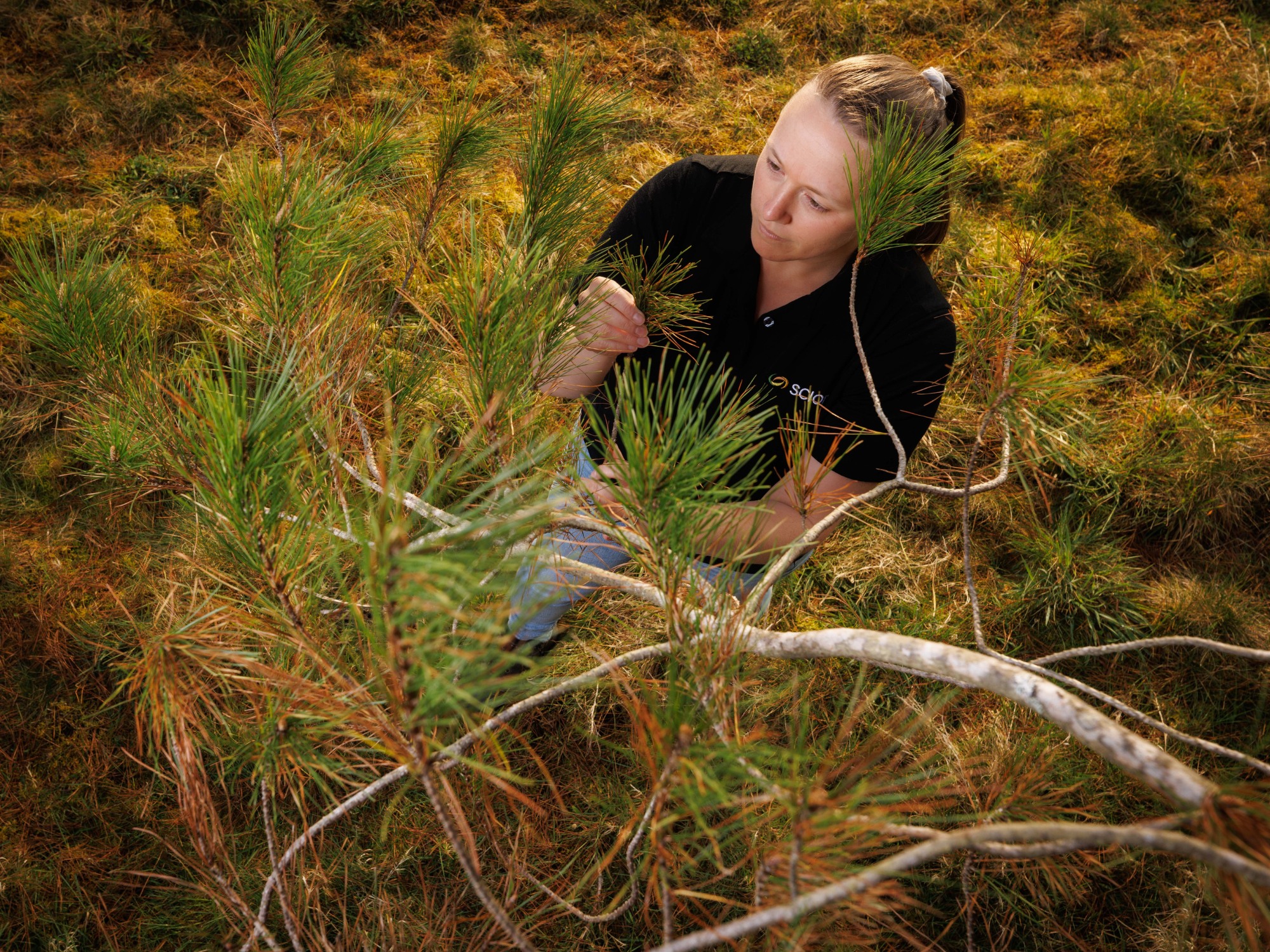
Emily McLay’s research helped to develop a model to predict red needle cast disease outbreaks
The Resilient Forests Programme has turned a poorly understood threat into something manageable, bridging the gap between research and on-the-ground decision-making for red needle cast, a relatively recent, high-impact needle disease of radiata pine. Through coordinated field trials, modelling and tool development, the programme has turned complex research on disease impacts, environmental drivers and control strategies into practical tools, giving foresters greater confidence in managing RNC.
The challenge
In the early 2000s, a new forest disease emerged in New Zealand – unseen anywhere in the world previously. The disease had no name, no known cause and no management strategy.
After its discovery, early research characterised the disease symptoms and identified the causal agent. We now know red needle cast (RNC) is caused by the aerial pathogen Phytophthora pluvialis. Although the pathogen has since been found in the USA and very recently in Europe, it is only in New Zealand that it impacts radiata pine. As a result, there is little relevant global information to inform management strategies. Early research with US collaborators confirmed that Phytophthora pluvialis was native to the Pacific Northwest of the US and identified potential pathways of introduction to NZ – which MPI have since tightened. Research then demonstrated that there was little risk of transporting the pathogen on exported logs – reassuring our international trading partners, protecting market access and addressing a major early concern from industry. RNC can develop rapidly but then seemingly disappear. Outbreaks can be localised. This unpredictability complicates both management strategies and the research required to develop them.
When the Resilient Forests Programme began in 2019, the industry had:
- growth impact data from a single RNC disease outbreak in one forest, with no knowledge of cumulative impacts over a rotation
- a framework for an epidemiological model to predict disease, but not the data required to parametrise, calibrate or validate it
- evidence that low-volume copper fungicide could reduce RNC severity, but no efficacy data under high disease pressure, no cost-benefit analysis, and no way to recommend when or where preventative control was needed. This left the industry facing a potentially high-impact but poorly understood disease, without the knowledge required to guide its management.
What we did
We redefined industry’s understanding of RNC, moving from limited site-specific observations of the disease to comprehensive knowledge of impacts, drivers and control strategies.
We have quantified the growth impacts of RNC to enable cost benefit analysis of management activities, determined the environmental drivers of disease outbreaks to enable foresters to predict when and where they would occur and when intervention would be required, and identified effective controls to reduce disease severity and impact.
Development of tools for application to both research and operational disease management has been crucial. This includes remote sensing methodologies for disease monitoring, diagnostic tools for pathogen detection, and sensor networks for environmental monitoring that feed real-time data into risk models that allow disease prediction.
We have maintained and established long-term field trials and infrastructure enabling us to assess disease impacts across a full rotation, obtain data to calibrate and validate predictive epidemiological models underpinning RNC risk decision support tools for foresters, and evaluate the efficacy of copper fungicide for control of RNC under severe disease pressure.
Based on current models, and at the worst case, we now know:
- Each severe RNC outbreak can reduce radial growth by up to 31% over 3 to 4 years. Recurring disease outbreaks every three to four years reduced radial area growth by 20% over a rotation, equivalent to a loss of up to 215 m3 ha-1 (16 %) volume and $21,688.75 ha-1 (17.3 %) value.
- How environmental factors (temperature and moisture) impact each stage of the RNC disease cycle.
- Low volume applications of copper fungicides at the same rate used to control Dothistroma reduce RNC. But sprays must be timed right – as they are preventative rather than curative.
The RNC Regional Risk Forecasting tool can be accessed at the FGR website. This digital tool provides a regional scale indication of the likelihood of an RNC outbreak, based on recent weather conditions. It is designed to help foresters understand when environmental conditions are becoming favourable for disease development.
What has changed so far?
Foresters highly value the foundational research carried out within the Resilient Forests Programme.
We really appreciate the work on red needle cast by the Resilient Forests team. The research has provided real insights on a disease that is having material impacts on our forests. We’re excited to see the results from the field trials we’ve hosted and the tools that have emerged. We’re keen to continue to work with the project team on improving the prototype red needle cast management tools and integrating them into our operations to manage the disease and protect our forests.
Like many forestry operators, Dothistroma is our focus, but we need to be aware and prepared for red needle cast. Given how hard it is to predict where RNC will appear and the speed with which it progresses it is an ominous opponent that we need to start preparing for. It’s a sleeping pathogen that, with the right conditions over consecutive years has potential to hit us hard. The potential implications for New Zealand’s forest industry, the community and the economy, are not to be understated. It’s imperative that we learn more about it and prepare now.”
What's next
FGR has secured PreSeed Accelerator Funding to further develop the existing tools.
Work is ongoing with Manulife, Juken, the Dothistroma Control Committee and the Forest Biosecurity Committee to operationalise the RNC Digital Infection Risk Tool and RNC Manual, including developing case study RNC management programmes with the two forestry companies.
Foresters see these kinds of risk tools as valuable for managing other major diseases, like Dothistroma needle blight and terminal crook, and for assessing future biosecurity threats such as brown spot needle blight. Their importance will grow as climate-driven weather variability increases.
Funding
Without combined support from the Forest Growers’ levy and Strategic Science Investment Funding through the Bioeconomy Science Institute, the forestry industry wouldn’t have a clear understanding of the issue. What was previously a serious threat to industry is now becoming manageable. Its impact is starting to be quantified and validated tools have been developed. The industry is much better prepared for when the next high-impact forest disease hits New Zealand.
The RNC digital tool can be accessed at the FGR website (https://fgr.nz/tools/red-needle-cast-regional-risk-forecasting/); it provides a regional scale indication of the likelihood of an RNC outbreak, based on recent weather conditions. It is designed to help foresters understand when environmental conditions are becoming favourable for disease development.
Read our comprehensive, end-to-end guide for understanding, predicting and managing RNC here. It covers integrated monitoring, modelling, chemical control, breeding and silvicultural strategies.
Facts and figures
Field trials:
- Six field trial series
- across more than 70 sites
- covering more than 200 hectares, and
- more than 100 field visits
Resilient Forests Programme Outputs:
- 27 technical reports
- 46 presentations
- 12 publications
- two industry workshops
Find the full list of publicly available outputs at https://fgr.nz/research-programmes/resilient-forests/
This impact case study was originally published by Forest Growers Research, republished here with permission.
For further information contact:
Dr Stuart Fraser, Research Group Leader, Ecology and Environment, Bioeconomy Science Institute (stuart.fraser@scionresearch.com)
Media contact
If you’re a journalist interested in this news, please contact a member of the communications team:
Greg Ford, Principal Communications Advisor
Email: greg.ford@agresearch.co.nz
Mobile: +64 (0)21 832 351
Justine McLeary, Senior Communications Advisor
Email: justine.mcleary@scionresearch.com
Mobile: +64 (0)27 241 5649
Maja Burry, Senior Communications Advisor
Email: maja.burry@plantandfood.co.nz
Mobile: +64 (0)27 437 5408