
Thursday, 2 April 2026
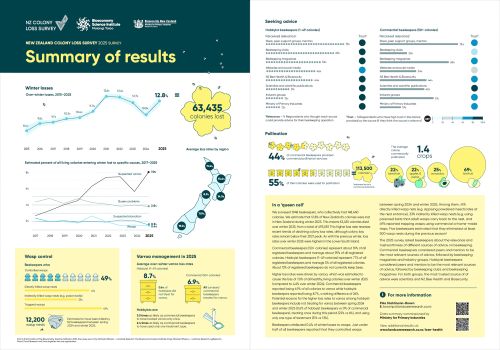
 In 2025 we surveyed 1,948 beekeepers, who collectively had 148,460 colonies. We estimate that 12.8% of New Zealand’s colonies were lost in New Zealand during winter 2025. This means 63,435 colonies died over winter 2025, from a total of 495,587. This higher loss rate reverses recent trends of declining colony loss rates, although colony loss rates remain below their 2021 peak. As with the previous winter, loss rates over winter 2025 were highest in the lower South Island.
Varroa mites are external parasites of honey bees, and also infect bee larvae as they develop and hatch. Severe infestations of varroa mites can weaken or destroy an entire colony. Colony losses attributed to varroa in 2025 were the highest ever recorded by the survey, with an estimated 7% of all healthy, living colonies dying over winter resulting from what beekeepers identified as varroa and related complications. There were more losses to varroa than to queen problems, suspected starvation, wasps, and all other causes combined. Losses attributed to varroa were especially high in the lower South Island.
The survey always includes ‘special topics’ as well as the core questions on overwinter losses and varroa management. One of the special topics in 2025 was about whether beekeepers control wasps. If they did, the survey further asked how they control wasps and how many wasp nests they think they killed.
Survey results show that that 49% of beekeepers control wasps. Among those who controlled wasps, about half used traps, 41% directly killed wasp nests, and 33% indirectly killed wasp nests. In total, the survey results suggest that New Zealand beekeepers killed 12,200 wasp nests over the past year, an enormous (and often uncredited) public service.
 More information
Pike Stahlmann-Brown, brownp@landcareresearch.co.nz
The New Zealand Colony Loss Survey is conducted each year on behalf of the New Zealand beekeeping industry and the Ministry for Primary Industries (MPI). The survey results are summarised here:
- 2025 Colony Loss Survey summary results (Bioeconomy Science Institute (Manaaki Whenua – Landcare Research Group)
- Colony Loss Survey 2025 Summary Infographic [PDF]
- Bee colony loss survey (Ministry for Primary Industries)
Media contact
If you’re a journalist interested in this news, please contact a member of the communications team:
Greg Ford, Principal Communications Advisor
Email: greg.ford@agresearch.co.nz
Mobile: +64 (0)21 832 351
Justine McLeary, Senior Communications Advisor
Email: justine.mcleary@scionresearch.com
Mobile: +64 (0)27 241 5649
Maja Burry, Senior Communications Advisor
Email: maja.burry@plantandfood.co.nz
Mobile: +64 (0)27 437 5408