
Wednesday, 24 June 2026
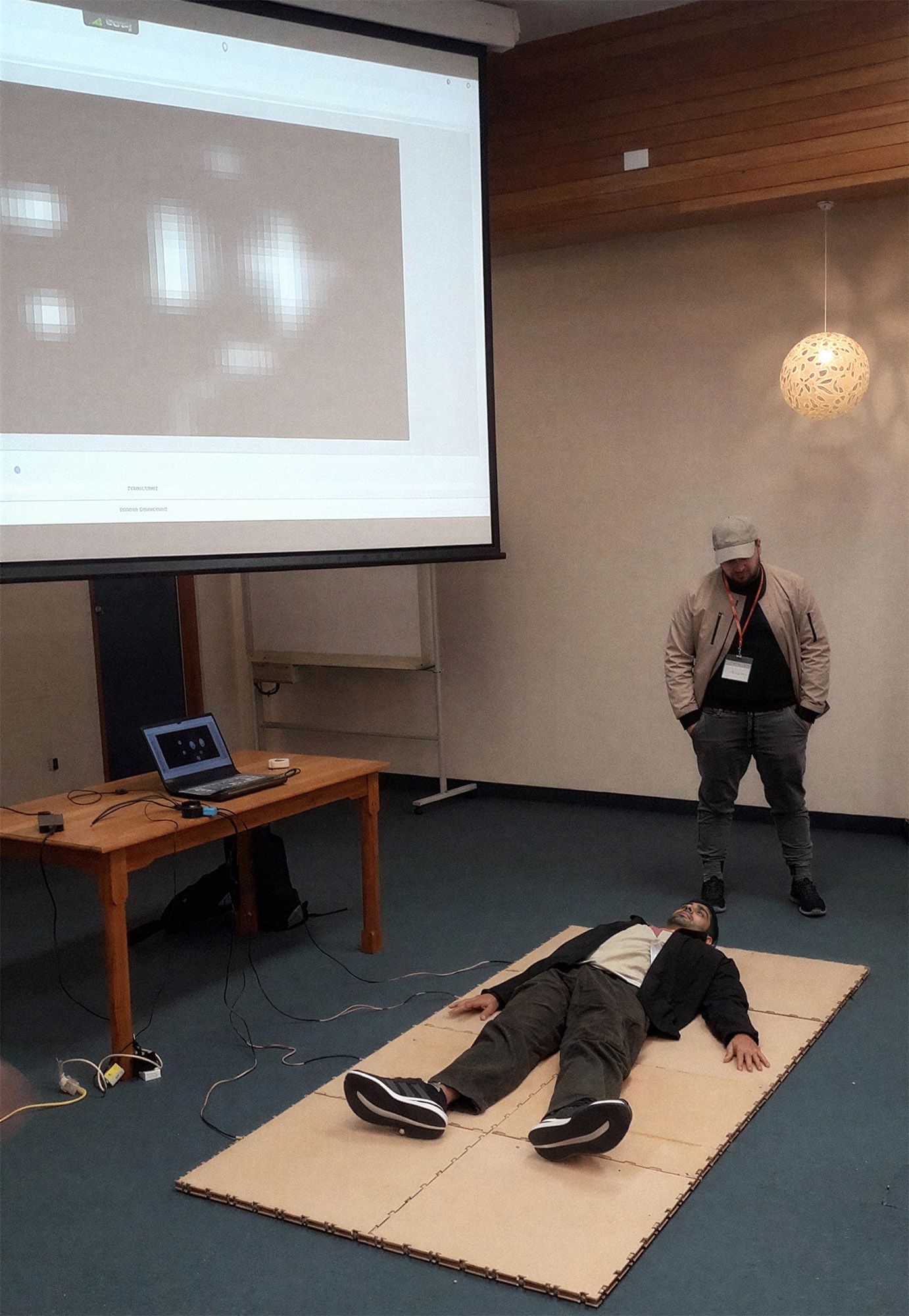
Members of the Smart Floors team showcased the prototype at the Bioeconomy Science Institute's Rotorua site last week.
The AUT-led Smart Floors project integrates discreet sensors beneath flooring to detect movement patterns, providing early insights into changes in mobility, behaviour and well-being. Designed to work with any flooring material, the sensors detect when someone has fallen and alerts help services.
The team is currently working to also identify increased fall risk or reduced activity, allowing for earlier intervention and improved health outcomes.
The AUT team visited the Bioeconomy Science Institute Maiangi Taiao’s Rotorua campus on June 19 to demonstrate a prototype.
Smart Floors require no cameras or wearable devices. Instead, intelligence is embedded within sustainably sourced wood fibre board flooring, enabling continuous, passive monitoring without disrupting daily life. Bioeconomy Science Institute scientists have provided expertise across carbon-based conductive inks printing and adhesives technology.
Polymer Chemistry team lead Robert Abbel says the project brings together expertise in wood science, engineering, architecture and health. “This highlights the potential to combine New Zealand’s forestry strengths with advanced digital technologies. The result is a high-value, data-enabled solution that extends the role of wood-based building products beyond traditional uses.
“The technology represents a significant opportunity for the bioeconomy. By integrating smart sensing into renewable materials, the project demonstrates how innovation can deliver economic value and social impact,” Robert says.
Auckland University of Technology project leader Prof. Fakhrul Alam says the Bioeconomy Science Institute was critical in the development of the Smart Floors prototype. “The materials science expertise helped us move beyond a proof of concept and create a system that can be integrated into real-world flooring products.
“We greatly appreciate the partnership and the collaborative approach that has helped bring this innovation closer to practical application.”
Smart Floors reflect a broader shift towards intelligent buildings that respond to occupant needs. As development progresses, the technology has potential applications across aged care, rehabilitation and residential housing markets.
Researchers say the project underscores the growing role of science and innovation in shaping healthier, more resilient communities—while opening new pathways for sustainable, high-tech wood products on the global stage.
Media contact
If you’re a journalist interested in this news, please contact a member of the communications team:
Greg Ford, Principal Communications Advisor
Email: greg.ford@agresearch.co.nz
Mobile: +64 (0)21 832 351
Justine McLeary, Senior Communications Advisor
Email: justine.mcleary@scionresearch.com
Mobile: +64 (0)27 241 5649
Maja Burry, Senior Communications Advisor
Email: maja.burry@plantandfood.co.nz
Mobile: +64 (0)27 437 5408