
Thursday, 1 January 2026
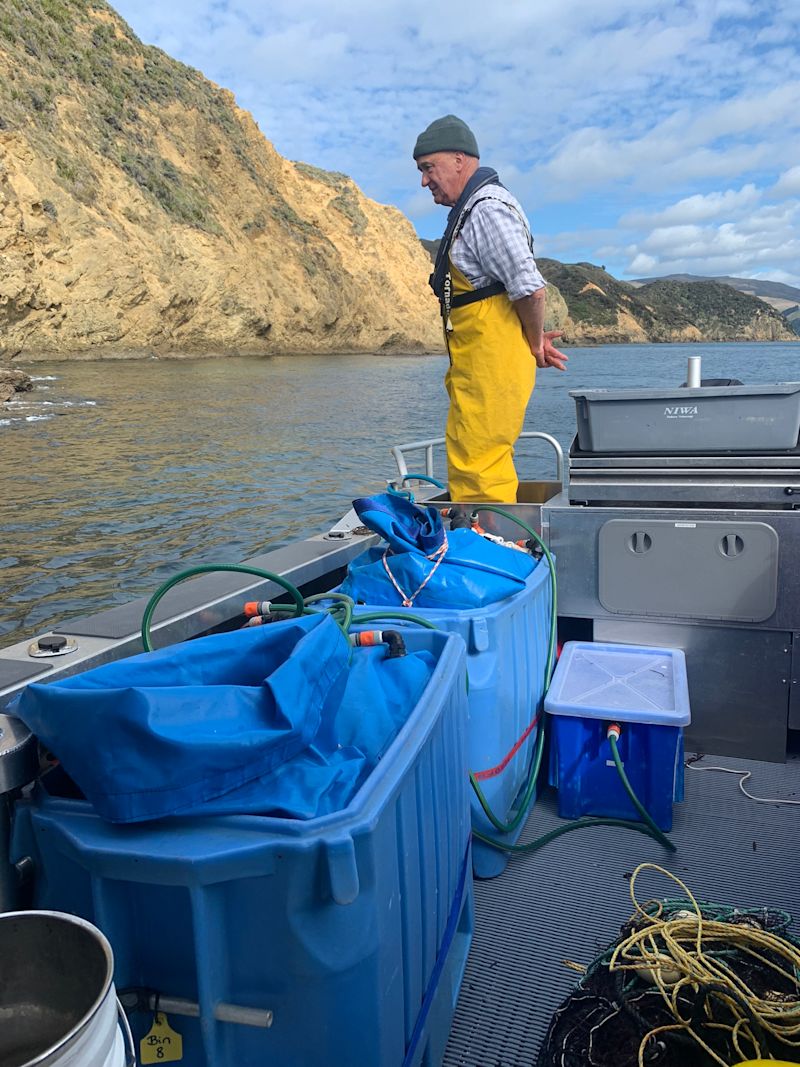
Kaumatua George Elkington on one of the mararī catching expeditions (with Rangitoto ki te tonga/D’Urville island in the background). These fish were caught with his brother’s nets.
Setting a vision through wānanga
The kaupapa emerged through a series of wānanga held between iwi partners and Rangahau Ahumāra Kai. These wānanga shaped a clear, values-based direction for the work ahead, one centred on the recognition of Mararī as a taonga from the outset.
Iwi aspirations included:
- High standards of taonga welfare
- Incorporating rongoā like kawakawa into aquafeeds
- Circular systems linking whenua and moana (ki uta ki tai)
- Understanding genetic diversity and integrating selective breeding
- Full utilisation of the fish
- Environmental restoration and intergenerational benefits
- Career pathways for rangatahi and mokopuna
By starting with these aspirations, the research programme could be built around iwi goals, not retrofitted to them.
Respecting tikanga in every step
One of the first practical steps was collecting live samples of mararī to keep in captivity to study. For Matua George and others involved, this was unfamiliar territory, not in terms of fishing, but in the act of catching to keep alive.
“Capturing and keeping them alive, then farming, that’s not something our iwi has done before with mararī,” he says. “But we’ve always had ways of showing respect. That’s the standard we brought to this.”
That meant carefully adapting practices to protect the fish during the collection process.
“We didn’t leave the nets in for more than an hour,” he explains. “With butterfish in the past, you might leave the net overnight. But not this time. We did everything we could to minimise stress and avoid unnecessary harm.”
That attention to kaitiakitanga echoed throughout the kaupapa and mirrored what was being observed in the fish themselves.
“They’re unusual,” Elkington says. “They’re vegetarians, not like most other species. And they’re curious. When we brought them into captivity, they’d come to the top and look at you, like they were trying to talk to you. There’s something special about them.”
A partnership built on listening
When Rangahau Ahumāra Kai, embark on a journey with Māori partners, they are committed to authentic engagement underpinned by a framework of Mātauranga and Taonga Principles. These principles support their aspirations while recognising and protecting taonga species, taonga works and indigenous knowledge.
Dr Hemi Cumming, Senior Scientist/Pou Tikanga Māori says “We’re committed to working with Māori and it’s imperative for us that when we engage, we do it in a way that is respectful of their role as kaitiaki over their taonga - indigenous flora and fauna. Our ‘Tono’ Māori strategy aims to build capability internally so that we’re creating enduring partnerships, it is with true mutual benefit in mind. It forces us to rethink how we engage in a way that is genuine and recognises Te Tiriti.”
One of the defining features of the project, according to Matua George, has been the respectful and open approach of the research team at Rangahau Ahumāra Kai, co-led by Dr Matthew Wylie and Dr Flavio Riberio.
“They’ve been excellent to work with,” he says. “They don’t come in saying, ‘We know everything, we just need your korowai.’ They want to know what we know. They’re willing to learn.”
For Matua George, who has decades of experience on and under the water, that openness has made all the difference.
“They’re not saying ‘this is how we’re doing it,’ they’re saying ‘how should we do this together?’ We can work with people like that.”
Seeding the future with care
This early-stage project is modest in scale, a small, strategic investment in both science and relationship. But its ambitions are whakapapa led. Iwi see the potential not just to farm mararī sustainably, but to restore what has been lost in the moana.
“If we can find a way to farm them that sustains and nourishes the species then that’s something. But it’s also about finding a way to strengthen the taiao, to bring back the kelp, and to support the food chain.”
Matua George believes that iwi hold deep knowledge that can benefit science, knowledge often unspoken, but learned through generations of practice and observation.
“There are things we were taught that we haven’t always had to explain,” he says. “Like not gutting hāpuku on the hāpuku grounds. If they bled there, the hāpuku would move off. My koro said that. So we only bled them in the bin. We knew these things and now, people are starting to ask us to share that.”
Looking ahead
The mararī project is still in its early stages. But already, it’s showing what’s possible when rangahau is shaped by whanaungatanga, and when taonga species are approached with the lens of kaitiakitanga.
“We’re not doing this just to farm a fish,” Matua George says. “We’re doing this because something’s wrong out there. The mararī need help and if we can help them survive, that’s what matters most.”
This story was originally published in October 2025 at plantandfood.com.
Media contact
Emma Timewell
Communications Manager
+64 (0)21 242 9365
emma.timewell@plantandfood.co.nz
Media contact
If you’re a journalist interested in this news, please contact a member of the communications team:
Greg Ford, Principal Communications Advisor
Email: greg.ford@agresearch.co.nz
Mobile: +64 (0)21 832 351
Justine McLeary, Senior Communications Advisor
Email: justine.mcleary@scionresearch.com
Mobile: +64 (0)27 241 5649
Maja Burry, Senior Communications Advisor
Email: maja.burry@plantandfood.co.nz
Mobile: +64 (0)27 437 5408