
Friday, 17 April 2026
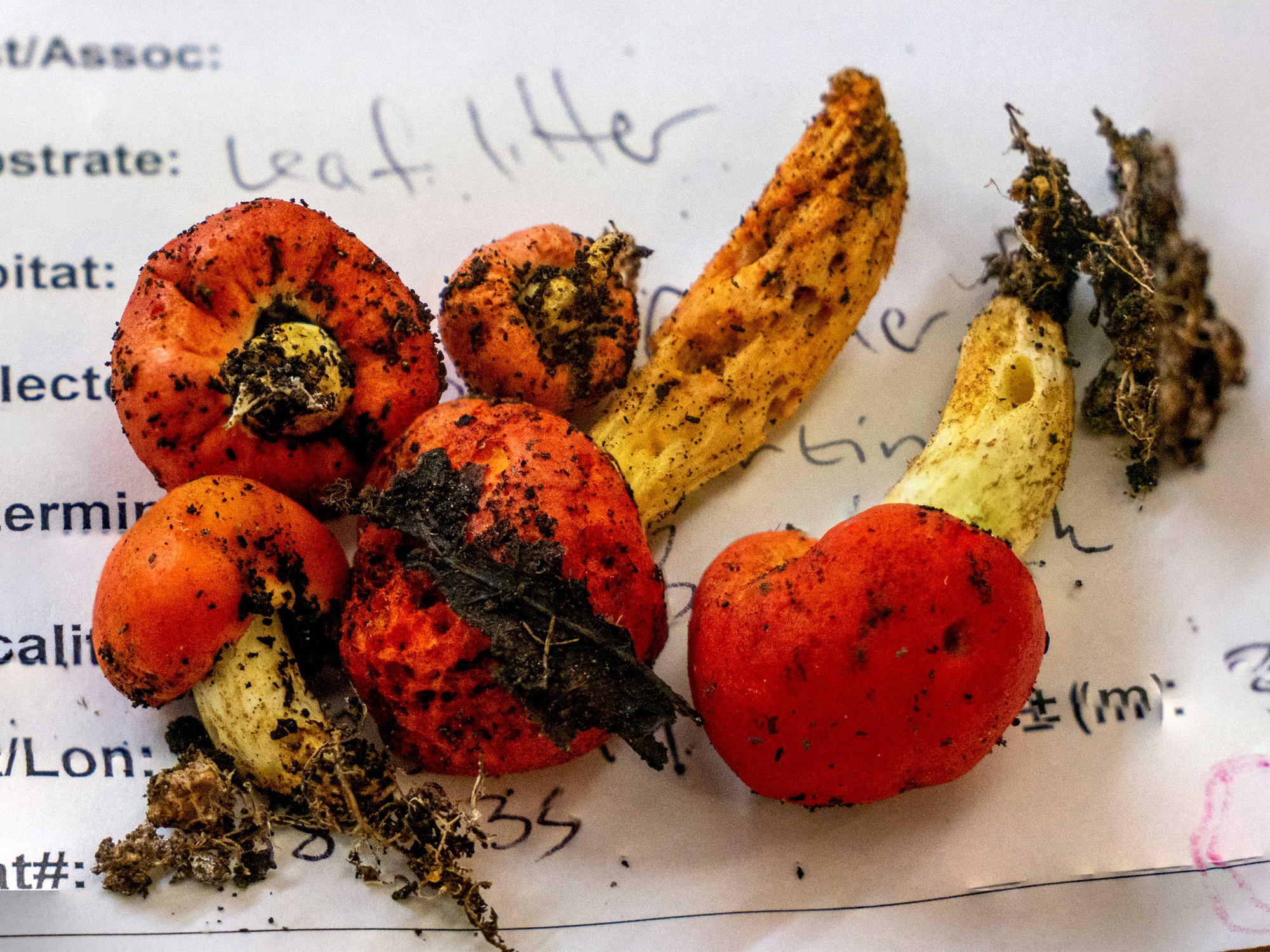
Fungal Foray specimen on the identification table
It’s actually the 40th anniversary of the Forays, which began in 1986, with just a few years missing during Covid. At each Foray, mycologists (fungal experts) and enthusiasts converge on a different location each year to find and scientifically identify as many fungi as they can.
The Forays are organised by the Fungal Network of New Zealand Inc. with members drawn from the Bioeconomy Science Institute Maiangi Taiao, universities, the Department of Conservation (DOC), iwi/hapu, non-government organisations, botanical societies, and the general community. Each year, the Foray aims to provide new knowledge of the fungi in our native forests and other environments, documenting new records of fungi, new host relationships, and possibly species new to science.
Karamea is a special location, with its forests having a reputation for being rich in fungi but largely unexplored, because of the remote end-of-the-road location of the township. It was a base for some targeted collecting by an important New Zealand mycologist in the 1960s, Dr Ross McNabb, who described several species new to science. Karamea’s nearby forests are therefore the “type locations” for several endemic species, so they have a rich history of scientific importance.
This Foray is the largest ever – with over 80 people registered to attend. There are several mycologists coming from Australia and North America. With permission from DOC, participants will be surveying approved native forests for fungi over four of the five weekdays. Selected specimens will be later deposited in the Nationally Significant Collections of the Bioeconomy Science Institute, dried fungal specimens in the New Zealand Fungarium, and living cultures in the International Collection of Microorganisms from Plants Culture Collection.
Coinciding with Conservation Week (20-26 April), this Fungal Foray will have a special emphasis on Fungal Conservation. Aotearoa NZ has over 30 fungal species listed on the international IUCN RED List of organisms threatened with extinction. At least one of these threatened fungi will be a focus for this foray at Karamea.
‘Tea-tree fingers’ (Hypocreopsis amplectans) is ranked internationally as Critically Endangered on the IUCN RED List, and Nationally Critical on NZ’s Threat Classification System Lists managed by DOC. Strangely, this species is native to both Aotearoa NZ and Victoria, Australia. In Australia, it is also considered Critically Endangered, but it has recently become better understood thanks to a government research grant to help safeguard its continued survival. Fortunately for NZ, two Australian researchers with extensive knowledge of tea-tree fingers will be joining in the Karamea Foray.
In New Zealand, tea-tree fingers is currently known from only 3 locations nationwide. Those records are a credit to fungal enthusiasts whose photographs lodged on the app iNaturalist NZ have enabled specialists to confirm identifications of this extremely rare fungus. One of those locations will be accessible to some forayers, and it is hoped that during Conservation Week we will learn more about proactive conservation of this enigmatic threatened fungus. Until its observation in 2023, at a different NZ location, it had not been seen in Aotearoa NZ for over 40 years!
On Wednesday 22 April a Colloquium (conference day) of papers will be presented by mycologists, mushrooms growers, and tertiary students. Students from Karamea School will be invited to visit our identification ‘lab’ to view our new fungal collections, and there’s a hosted public walk organised on Tuesday 21 April in the morning (Guided Fungi Walk | Karamea.nz)
Fungus of the Year 2026
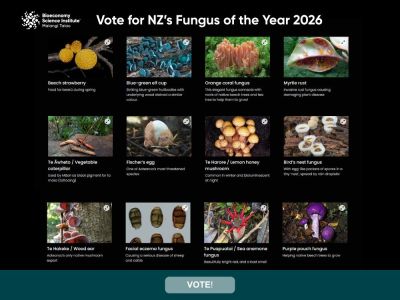 The Fungal Foray is again promoting its online “Fungus of the Year” poll to engage and raise the profile of often-overlooked fungi.
Vote for your favourite fungus among the 12 candidates, or maybe vote for a fungus that is threatened, or culturally important, or edible, or (on the negative side) one that’s causing an important disease. As a Kingdom entirely separate from plants, and more closely related to animals, fungi come in so many shapes, colours and forms.
The previous winners from the first Fungus of the Year promotion, and from last year’s poll, have been removed and replaced for 2026. Past winners were Te Werewere-Kōkako (sky-blue Entoloma) as featured on the NZ$50 banknote, and Te Matakupenga (basket fungus).
More information
Contact: Peter Buchanan buchananp@landcareresearch.co.nz / 0274 341 832
Media contact
If you’re a journalist interested in this news, please contact a member of the communications team:
Greg Ford, Principal Communications Advisor
Email: greg.ford@agresearch.co.nz
Mobile: +64 (0)21 832 351
Justine McLeary, Senior Communications Advisor
Email: justine.mcleary@scionresearch.com
Mobile: +64 (0)27 241 5649
Maja Burry, Senior Communications Advisor
Email: maja.burry@plantandfood.co.nz
Mobile: +64 (0)27 437 5408