
Monday, 25 May 2026
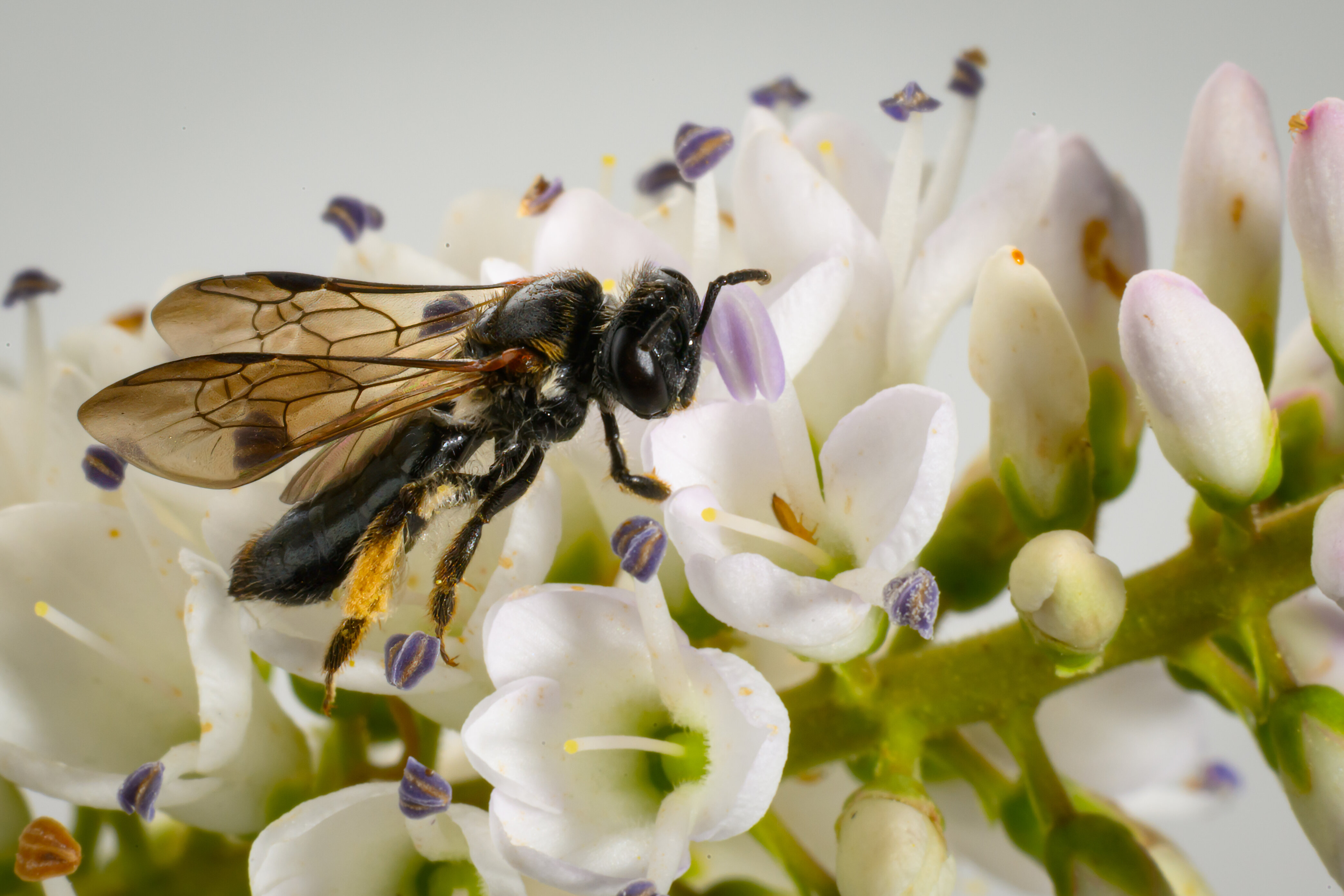
Leioproctus launcestonensis.
A bee species from Australia that has not been formally observed in New Zealand for over 65 years has been spotted in Christchurch, with multiple detections made across the city during recent pollinator surveys.
Historically, a single male specimen of Leioproctus launcestonensis, which is considered very unlikely to present a biosecurity risk, was recorded in Christchurch in 1959. However, in 2010 a bee expert concluded that the species had not established, with no evidence of a wider population.
Recent findings now challenge this view. Fifteen individuals have been formally identified after being collected from community gardens in Lyttelton, Ilam, Spreydon, Woolston, Lincoln and Leeston, with additional sightings made by members of the public.
Leioproctus launcestonensis is a small, solitary, soil-nesting bee measuring 6-8 mm in length. Like most other bee species globally, they are flower visitors which collect pollen and nectar. Other Leioproctus bee species in New Zealand have been found to be excellent crop pollinators that play a valuable role in urban gardens and farms.
In collaboration with the Bioeconomy Science Institute Maiangi Taiao, University of Canterbury PhD candidate Ava Taylor-Johnson has been conducting surveys in 14 community gardens, exploring how garden size, plant diversity, and surrounding landscapes affect pollinator populations.
Insect samples collected by Ava Taylor-Johnson were formally identified at the Bioeconomy Science Institute’s entomology lab in Lincoln.
Sam Read from the Institute’s Beneficial Biodiversity Research team says New Zealand is home to 28 indigenous bee species, many of which are notoriously difficult to tell apart.
“Several specimens collected during Ava’s project were sent for DNA barcoding. During this process, we discovered that the DNA of some bees Ava had collected did not match any known native Leioproctus species. Further analysis revealed that they instead matched the DNA of an Australian species.”
“Closer examination revealed that unlike other Leioproctus species in Australia and New Zealand, this species has bright orange-red tegulae — which are small plates found at the base of the wings.”
The finding was reported to Biosecurity New Zealand and incursion investigators there looked into it.
Director Diagnostics, Readiness and Surveillance, Fleur Francois, says despite the infrequent observations over the years, the species is likely to be established here.
“It is very unlikely to cause a biosecurity risk as it belongs to a genus of pollinating species with no known harmful impacts in New Zealand. We will add a specimen to our insect reference collection.”
Citizen scientists have also unknowingly contributed to the discovery. Around five observations have been uploaded to the online platform iNaturalist between 2021 and 2025, showing what is now known to be Leioproctus launcestonensis present in locations including Hagley Park, Beckenham, and Lincoln.
Media contact
If you’re a journalist interested in this news, please contact a member of the communications team:
Greg Ford, Principal Communications Advisor
Email: greg.ford@agresearch.co.nz
Mobile: +64 (0)21 832 351
Justine McLeary, Senior Communications Advisor
Email: justine.mcleary@scionresearch.com
Mobile: +64 (0)27 241 5649
Maja Burry, Senior Communications Advisor
Email: maja.burry@plantandfood.co.nz
Mobile: +64 (0)27 437 5408