
Monday, 8 December 2025

Results from the case study highlight that New Zealand’s planted forests contain substantial stocks of deep soil organic carbon, much of which is older than the current forest land use. Although this deep soil carbon appears stable, the international research shows that climate change could release this deep soil carbon to the atmosphere.
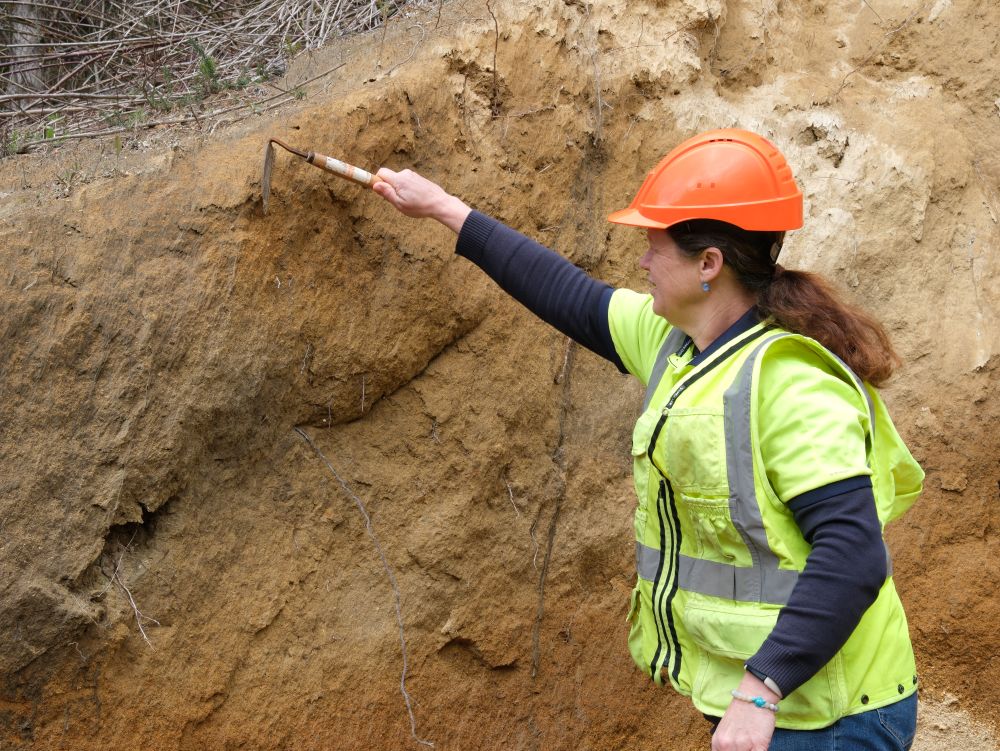
Most soil studies only go down to 30cm so Loretta and team explored down to a depth of 2m to tackle this knowledge gap. Soil samples were collected at 15 New Zealand sites to look at carbon deeper in the soil.
Why it matters?
Sampling to 30cm misses more than half of the carbon that is actually there. The concern is that if this deep soil carbon is lost to the atmosphere as the climate warms, it could accelerate global warming, degrade soil health, and undermine forest resilience. Importantly, because trees can be deep rooting there is an opportuntiy for forest management to help mitigate any potential carbon loss.
The Bioeconomy Science Institute has strong history of researching New Zealand soils, with experts supporting sustainable and productive landscapes.
Where to next?
This case study has highlighted a need to understand deep soil processes that underpin both carbon security and forest productivity within New Zealand planted forests. What is needed now is a robust baseline to support predicting future risks to deep soil carbon and opportunities to manage planted forests for a resilient future.
Read the full paper: Lifting the profile of deep soil carbon in New Zealand's managed planted forests.
Garrett, L.G., Heckman, K.A., Possinger, A.R. et al. Lifting the profile of deep soil carbon in New Zealand’s managed planted forests. Carbon Balance Manage 20, 28 (2025). https://doi.org/10.1186/s13021-025-00323-2
Media contact
If you’re a journalist interested in this news, please contact a member of the communications team:
Greg Ford, Principal Communications Advisor
Email: greg.ford@agresearch.co.nz
Mobile: +64 (0)21 832 351
Justine McLeary, Senior Communications Advisor
Email: justine.mcleary@scionresearch.com
Mobile: +64 (0)27 241 5649
Maja Burry, Senior Communications Advisor
Email: maja.burry@plantandfood.co.nz
Mobile: +64 (0)27 437 5408