
Friday, 19 December 2025
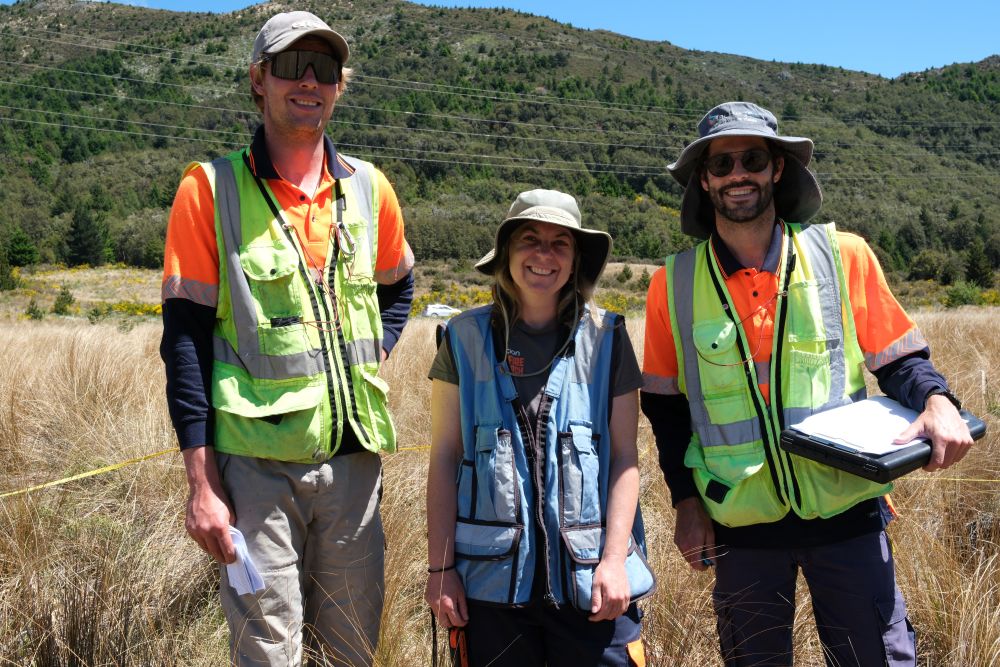
Research assistant Ryan Vorster (left), fire ecologist Shana Gross (centre) and field technician Pedro Capelino (right).
Shana Gross, fire ecologist and science leader of wildfire research at the Bioeconomy Science Institute, explains that fuel is an important aspect of fire behaviour and leveraging satellite data will help fill a gap. Understanding moisture levels in fuels using regular on the ground measurements and linking those with the satellite data and other remotely sensed datasets will enable enhanced accuracy in moisture detection across New Zealand’s diverse landscapes.
Why this research matters?
Accurate knowledge of vegetation characteristics, including LFMC, are critical for assessing fire risk across the landscape. Vegetation type and percent moisture influence ignition potential and fire spread. Traditional ground-based measurements are labour-intensive and limited in scope, but this remote sensing approach offers scalable, near-real-time insights.
The research, supported by the Ministry of Business, Innovation and Employment (MBIE), underscores the growing role of combining field data and satellite date in environmental monitoring. By integrating advanced modelling with satellite imagery, the team aims to provide land manager s, planners and emergency services with actionable data to mitigate wildfire impacts.
New Zealand wildfire research
The Rural Fire Research Team at the Bioeconomy Science Institute is New Zealand’s leading wildfire research group. With over 30 years’ experience researching fire behaviour in diverse and complex environments and weather conditions, and collaborating closely with communities, we develop science and technology that safeguard communities and landscapes to help New Zealand prepare for living in a wildfire prone environment.
This latest research is part of our collaboration with NASA’s Ames Research Centre, the Australian National University, the US Forest Service, The 3-year project is funded by the Ministry of Business, Innovation and Employment (MBIE), receiving $1.28 million from the Catalyst Fund (strategic).
Read the roadmap for how we will develop the system:
Watt, M.S., Gross, S., Difuntorum, J.K., McCarty, J.L., Pearce, H.G., Shuman, J.K., Yebra, M (2025) Monitoring Wildfire Risk with a Near-Real-Time Live Fuel Moisture Content System: A Review and Roadmap for Operational Application in New Zealand. Remote Sens. 2025, 17(21), 3580; https://doi.org/10.3390/rs17213580
Related links:
- Wildfire research website
- Near real time fuel moisture and fuel type system for wildfire and drought
- Scion funding for NASA water, wildfire research collaboration
Media contact
If you’re a journalist interested in this news, please contact a member of the communications team:
Greg Ford, Principal Communications Advisor
Email: greg.ford@agresearch.co.nz
Mobile: +64 (0)21 832 351
Justine McLeary, Senior Communications Advisor
Email: justine.mcleary@scionresearch.com
Mobile: +64 (0)27 241 5649
Maja Burry, Senior Communications Advisor
Email: maja.burry@plantandfood.co.nz
Mobile: +64 (0)27 437 5408